 Add to Chrome
 Add to Firefox
 Add to Edge
Can VLMs Truly Forget? Benchmarking Training-Free Visual Concept Unlearning
Apr 03, 2026
VLMs trained on web-scale data retain sensitive and copyrighted visual concepts that deployment may require removing. Training-based unlearning methods share a structural flaw: fine-tuning on a narrow forget set degrades general capabilities before unlearning begins, making it impossible to attribute subsequent performance drops to the unlearning procedure itself. Training-free approaches sidestep this by suppressing concepts through prompts or system instructions, but no rigorous benchmark exists for evaluating them on visual tasks. We introduce VLM-UnBench, the first benchmark for training-free visual concept unlearning in VLMs. It covers four forgetting levels, 7 source datasets, and 11 concept axes, and pairs a three-level probe taxonomy with five evaluation conditions to separate genuine forgetting from instruction compliance. Across 8 evaluation settings and 13 VLM configurations, realistic unlearning prompts leave forget accuracy near the no-instruction baseline; meaningful reductions appear only under oracle conditions that disclose the target concept to the model. Object and scene concepts are the most resistant to suppression, and stronger instruction-tuned models remain capable despite explicit forget instructions. These results expose a clear gap between prompt-level suppression and true visual concept erasure.

Why Instruction-Based Unlearning Fails in Diffusion Models?
Apr 02, 2026Instruction-based unlearning has proven effective for modifying the behavior of large language models at inference time, but whether this paradigm extends to other generative models remains unclear. In this work, we investigate instruction-based unlearning in diffusion-based image generation models and show, through controlled experiments across multiple concepts and prompt variants, that diffusion models systematically fail to suppress targeted concepts when guided solely by natural-language unlearning instructions. By analyzing both the CLIP text encoder and cross-attention dynamics during the denoising process, we find that unlearning instructions do not induce sustained reductions in attention to the targeted concept tokens, causing the targeted concept representations to persist throughout generation. These results reveal a fundamental limitation of prompt-level instruction in diffusion models and suggest that effective unlearning requires interventions beyond inference-time language control.
TDMM-LM: Bridging Facial Understanding and Animation via Language Models
Mar 14, 2026Text-guided human body animation has advanced rapidly, yet facial animation lags due to the scarcity of well-annotated, text-paired facial corpora. To close this gap, we leverage foundation generative models to synthesize a large, balanced corpus of facial behavior. We design prompts suite covering emotions and head motions, generate about 80 hours of facial videos with multiple generators, and fit per-frame 3D facial parameters, yielding large-scale (prompt and parameter) pairs for training. Building on this dataset, we probe language models for bidirectional competence over facial motion via two complementary tasks: (1) Motion2Language: given a sequence of 3D facial parameters, the model produces natural-language descriptions capturing content, style, and dynamics; and (2) Language2Motion: given a prompt, the model synthesizes the corresponding sequence of 3D facial parameters via quantized motion tokens for downstream animation. Extensive experiments show that in this setting language models can both interpret and synthesize facial motion with strong generalization. To best of our knowledge, this is the first work to cast facial-parameter modeling as a language problem, establishing a unified path for text-conditioned facial animation and motion understanding.
Training Large Reasoning Models Efficiently via Progressive Thought Encoding
Feb 18, 2026Large reasoning models (LRMs) excel on complex problems but face a critical barrier to efficiency: reinforcement learning (RL) training requires long rollouts for outcome-based rewards, where autoregressive decoding dominates time and memory usage. While sliding-window cache strategies can bound memory, they disrupt long-context reasoning and degrade performance. We introduce Progressive Thought Encoding, a parameter-efficient fine-tuning method that enables LRMs to reason effectively under fixed-size caches. By progressively encoding intermediate reasoning into fixed-size vector representations, our approach eliminates the need to backpropagate through full-cache rollouts, thereby reducing memory usage, while maintaining constant memory during inference. Experiments on three models, including Qwen2.5-3B-Instruct, Qwen2.5-7B-Instruct, and DeepSeek-R1-Distill-Llama-8B, on six widely used challenging mathematical benchmarks show consistent gains: our method achieves +19.3% improvement over LoRA-based fine-tuning and +29.9% over LRMs without fine-tuning on average, with up to +23.4 accuracy improvement on AIME2024/2025 under the same tight cache budgets. These results demonstrate that Progressive Thought Encoding not only improves reasoning accuracy but also makes RL training of LRMs substantially more efficient and scalable under real-world memory constraints.
SEMA: Simple yet Effective Learning for Multi-Turn Jailbreak Attacks
Feb 06, 2026Multi-turn jailbreaks capture the real threat model for safety-aligned chatbots, where single-turn attacks are merely a special case. Yet existing approaches break under exploration complexity and intent drift. We propose SEMA, a simple yet effective framework that trains a multi-turn attacker without relying on any existing strategies or external data. SEMA comprises two stages. Prefilling self-tuning enables usable rollouts by fine-tuning on non-refusal, well-structured, multi-turn adversarial prompts that are self-generated with a minimal prefix, thereby stabilizing subsequent learning. Reinforcement learning with intent-drift-aware reward trains the attacker to elicit valid multi-turn adversarial prompts while maintaining the same harmful objective. We anchor harmful intent in multi-turn jailbreaks via an intent-drift-aware reward that combines intent alignment, compliance risk, and level of detail. Our open-loop attack regime avoids dependence on victim feedback, unifies single- and multi-turn settings, and reduces exploration complexity. Across multiple datasets, victim models, and jailbreak judges, our method achieves state-of-the-art (SOTA) attack success rates (ASR), outperforming all single-turn baselines, manually scripted and template-driven multi-turn baselines, as well as our SFT (Supervised Fine-Tuning) and DPO (Direct Preference Optimization) variants. For instance, SEMA performs an average $80.1\%$ ASR@1 across three closed-source and open-source victim models on AdvBench, 33.9% over SOTA. The approach is compact, reproducible, and transfers across targets, providing a stronger and more realistic stress test for large language model (LLM) safety and enabling automatic redteaming to expose and localize failure modes. Our code is available at: https://github.com/fmmarkmq/SEMA.
Omni-Judge: Can Omni-LLMs Serve as Human-Aligned Judges for Text-Conditioned Audio-Video Generation?
Feb 02, 2026State-of-the-art text-to-video generation models such as Sora 2 and Veo 3 can now produce high-fidelity videos with synchronized audio directly from a textual prompt, marking a new milestone in multi-modal generation. However, evaluating such tri-modal outputs remains an unsolved challenge. Human evaluation is reliable but costly and difficult to scale, while traditional automatic metrics, such as FVD, CLAP, and ViCLIP, focus on isolated modality pairs, struggle with complex prompts, and provide limited interpretability. Omni-modal large language models (omni-LLMs) present a promising alternative: they naturally process audio, video, and text, support rich reasoning, and offer interpretable chain-of-thought feedback. Driven by this, we introduce Omni-Judge, a study assessing whether omni-LLMs can serve as human-aligned judges for text-conditioned audio-video generation. Across nine perceptual and alignment metrics, Omni-Judge achieves correlation comparable to traditional metrics and excels on semantically demanding tasks such as audio-text alignment, video-text alignment, and audio-video-text coherence. It underperforms on high-FPS perceptual metrics, including video quality and audio-video synchronization, due to limited temporal resolution. Omni-Judge provides interpretable explanations that expose semantic or physical inconsistencies, enabling practical downstream uses such as feedback-based refinement. Our findings highlight both the potential and current limitations of omni-LLMs as unified evaluators for multi-modal generation.
Statistical Estimation of Adversarial Risk in Large Language Models under Best-of-N Sampling
Jan 30, 2026Large Language Models (LLMs) are typically evaluated for safety under single-shot or low-budget adversarial prompting, which underestimates real-world risk. In practice, attackers can exploit large-scale parallel sampling to repeatedly probe a model until a harmful response is produced. While recent work shows that attack success increases with repeated sampling, principled methods for predicting large-scale adversarial risk remain limited. We propose a scaling-aware Best-of-N estimation of risk, SABER, for modeling jailbreak vulnerability under Best-of-N sampling. We model sample-level success probabilities using a Beta distribution, the conjugate prior of the Bernoulli distribution, and derive an analytic scaling law that enables reliable extrapolation of large-N attack success rates from small-budget measurements. Using only n=100 samples, our anchored estimator predicts ASR@1000 with a mean absolute error of 1.66, compared to 12.04 for the baseline, which is an 86.2% reduction in estimation error. Our results reveal heterogeneous risk scaling profiles and show that models appearing robust under standard evaluation can experience rapid nonlinear risk amplification under parallel adversarial pressure. This work provides a low-cost, scalable methodology for realistic LLM safety assessment. We will release our code and evaluation scripts upon publication to future research.
Semantic visually-guided acoustic highlighting with large vision-language models
Jan 12, 2026Balancing dialogue, music, and sound effects with accompanying video is crucial for immersive storytelling, yet current audio mixing workflows remain largely manual and labor-intensive. While recent advancements have introduced the visually guided acoustic highlighting task, which implicitly rebalances audio sources using multimodal guidance, it remains unclear which visual aspects are most effective as conditioning signals.We address this gap through a systematic study of whether deep video understanding improves audio remixing. Using textual descriptions as a proxy for visual analysis, we prompt large vision-language models to extract six types of visual-semantic aspects, including object and character appearance, emotion, camera focus, tone, scene background, and inferred sound-related cues. Through extensive experiments, camera focus, tone, and scene background consistently yield the largest improvements in perceptual mix quality over state-of-the-art baselines. Our findings (i) identify which visual-semantic cues most strongly support coherent and visually aligned audio remixing, and (ii) outline a practical path toward automating cinema-grade sound design using lightweight guidance derived from large vision-language models.
When to Think and When to Look: Uncertainty-Guided Lookback
Nov 19, 2025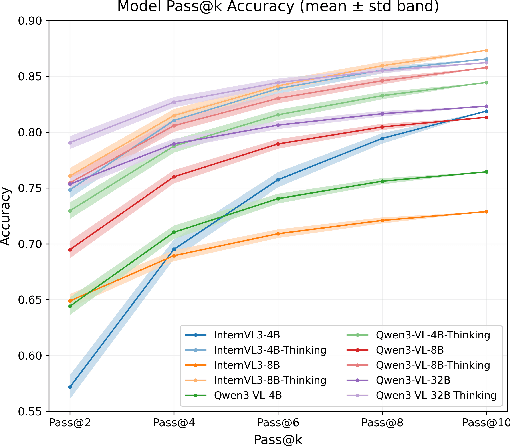

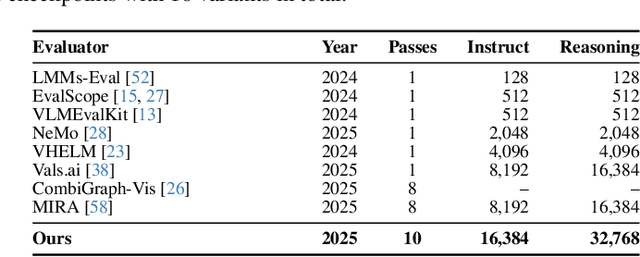
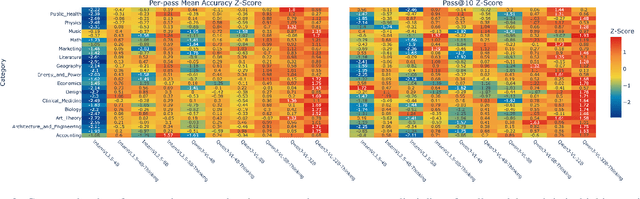
Test-time thinking (that is, generating explicit intermediate reasoning chains) is known to boost performance in large language models and has recently shown strong gains for large vision language models (LVLMs). However, despite these promising results, there is still no systematic analysis of how thinking actually affects visual reasoning. We provide the first such analysis with a large scale, controlled comparison of thinking for LVLMs, evaluating ten variants from the InternVL3.5 and Qwen3-VL families on MMMU-val under generous token budgets and multi pass decoding. We show that more thinking is not always better; long chains often yield long wrong trajectories that ignore the image and underperform the same models run in standard instruct mode. A deeper analysis reveals that certain short lookback phrases, which explicitly refer back to the image, are strongly enriched in successful trajectories and correlate with better visual grounding. Building on this insight, we propose uncertainty guided lookback, a training free decoding strategy that combines an uncertainty signal with adaptive lookback prompts and breadth search. Our method improves overall MMMU performance, delivers the largest gains in categories where standard thinking is weak, and outperforms several strong decoding baselines, setting a new state of the art under fixed model families and token budgets. We further show that this decoding strategy generalizes, yielding consistent improvements on five additional benchmarks, including two broad multimodal suites and math focused visual reasoning datasets.
PromptReverb: Multimodal Room Impulse Response Generation Through Latent Rectified Flow Matching
Oct 25, 2025Room impulse response (RIR) generation remains a critical challenge for creating immersive virtual acoustic environments. Current methods suffer from two fundamental limitations: the scarcity of full-band RIR datasets and the inability of existing models to generate acoustically accurate responses from diverse input modalities. We present PromptReverb, a two-stage generative framework that addresses these challenges. Our approach combines a variational autoencoder that upsamples band-limited RIRs to full-band quality (48 kHz), and a conditional diffusion transformer model based on rectified flow matching that generates RIRs from descriptions in natural language. Empirical evaluation demonstrates that PromptReverb produces RIRs with superior perceptual quality and acoustic accuracy compared to existing methods, achieving 8.8% mean RT60 error compared to -37% for widely used baselines and yielding more realistic room-acoustic parameters. Our method enables practical applications in virtual reality, architectural acoustics, and audio production where flexible, high-quality RIR synthesis is essential.